Guides
Selling gold: where to sell and what to look for
How to recognise a reputable gold buyer, and how banks, jewellers, online buyers, refineries and local buyers compare.
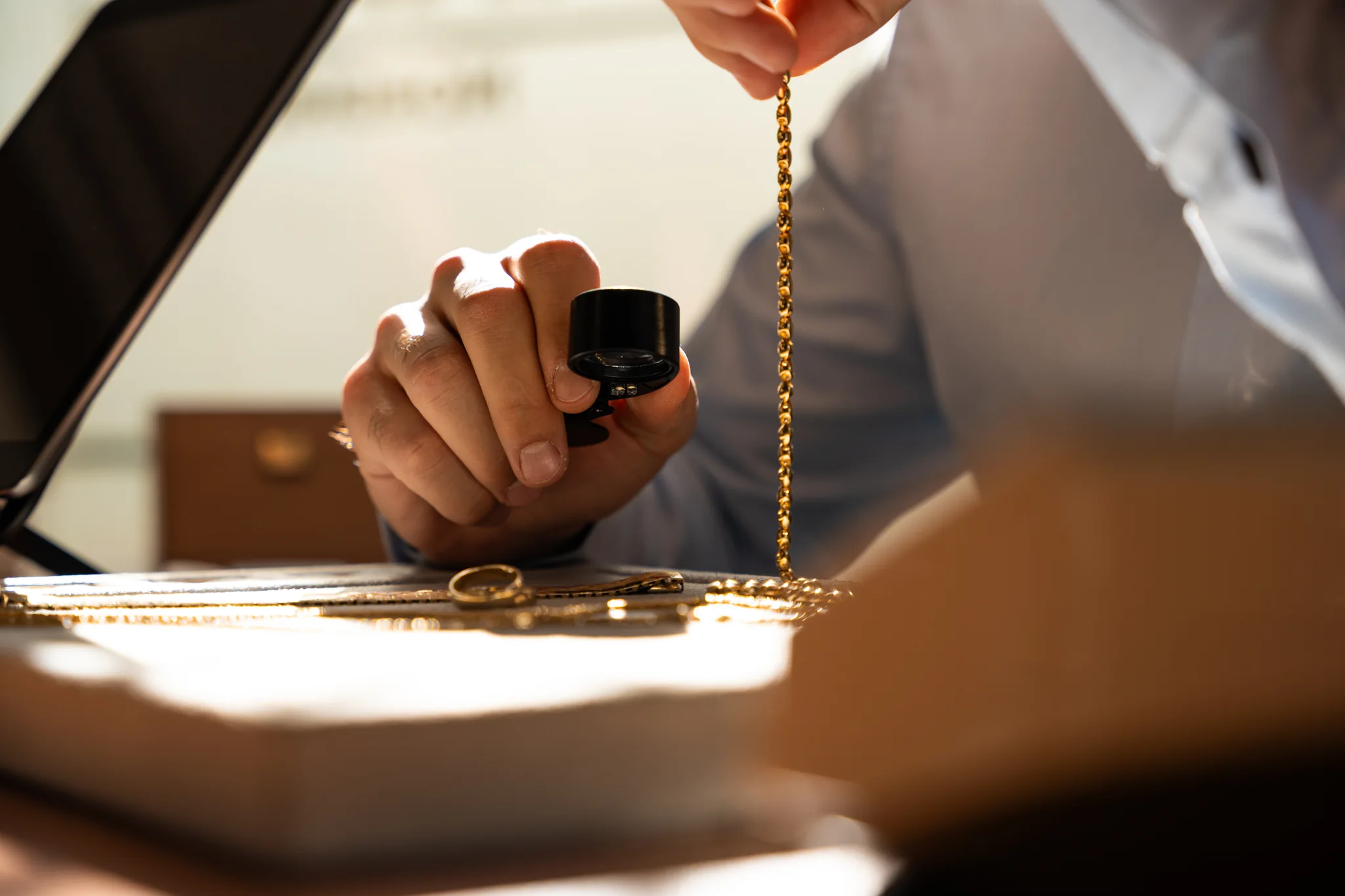
Plenty of businesses want to buy gold today: banks, jewellers, online buyers, refineries and gold buying shops. What you end up with depends less on the name above the door than on the calculation you are shown. This guide explains how to recognise a reputable gold buyer, what speaks for and against each option and what to prepare before you sell.
How do I recognise a reputable gold buyer?
First, by the calculation. Every buying price is made up of four figures: the current gold price, the fineness of your piece, its weight and the buying rate, which is the share of the material value that is paid out. A reputable buyer tells you all four before you agree, and you can check the result with a calculator.
Testing and weighing happen in front of you, on a calibrated scale and separated by fineness. A buyer who weighs 333, 585 and 750 jewellery together and pays for everything as 333 is shrinking its value. Deductions for stones, steel springs or other parts are named before the calculation, not only on the receipt.
Nobody pressures you. Because the price fluctuates, an offer only ever applies to that moment, but the valuation itself does not commit you to anything, and you can say no without paying a thing. Be wary of offers that are supposedly valid only today, of fees that only appear at the till and of buyers who will not tell you the price they use.
Finally, you receive a written receipt with the date, the individual items and the amount paid out. The calculation with price, fineness and weight was shown to you openly beforehand, and the receipt is your proof should the tax office ask about the sale later.
Where is the best place to sell gold?
That depends on what you are selling. Gold bars and bullion coins have a fixed weight and a known fineness, so the buying rate is almost the only thing that matters. With jewellery, scrap gold and dental gold, the gold content has to be tested first, and that is exactly where two offers can be far apart.
You have five options: the bank, the jeweller, an online buyer by post, a refinery and a local buying shop. None of them is best for everyone. Test each one with the same questions: Am I told the price used? Is the fineness tested while I watch? Is the rate fixed before I agree? Is the money paid out immediately, and what does this route cost me?

Selling gold at a bank
Whether a bank buys back gold, which pieces it accepts and at what price is up to each bank. For bars and coins you bought from your bank, it is an obvious first port of call.
Ask in advance: Does the bank also accept pieces bought elsewhere? Does that include jewellery and old gold? Which price is used, are there fees, and is the money paid out immediately or only after testing? With these answers you can put the bank's offer right next to any other.
Selling gold to a jeweller
Depending on the shop, jewellers and goldsmiths take old gold for cash or credit it towards new jewellery or a remodel. That can pay off if you were planning to have something made anyway. In that case, ask what amount is credited for your old gold and whether you would also be paid that amount without buying anything new.
With designer jewellery, special craftsmanship or pieces with gemstones, the value as jewellery can exceed the gold value. So do not have such pieces valued by weight alone; ask explicitly for both. We too check whether designer jewellery is worth more than its gold.
Selling gold online: buyers by post
With an online buyer you send your gold by post, depending on the company in a shipping bag or with a shipping label, and after testing you receive an offer or a payment straight away. That is convenient if there is no buyer near you, and straightforward for bars and coins with a known weight.
The downside: you see neither the weighing nor the testing, and your gold is on its way before you know a binding price. Clarify in advance up to what value the parcel is insured, whether you get a firm offer before the sale and what the return costs if you do not accept. Weigh and photograph your pieces before sending them.
Selling gold to a refinery
At a refinery, old gold is melted down and separated into pure gold and the other metals. Some refineries also buy directly from private sellers; depending on the company, payment is then based on an analysis of the melted material. Ask in advance about minimum quantities, analysis fees and when you will be paid.
For large amounts of scrap gold the direct route can be worthwhile; for a jewellery box from an estate it is often cumbersome. We also pass our old gold on to a refinery, but we pay you its value immediately, without you waiting for an analysis.
Selling gold locally: at a buying shop
At a buying shop your gold lies on the counter while it is tested and weighed. You hear the price straight away, can ask questions, decline or sell, and receive the money directly, in cash or by bank transfer. In return you have to travel there once, and as with every option there are better and worse buyers: the checklist above applies here too.
What do I need to bring to sell gold?
Above all your pieces, just as they are. You do not need to clean, sort or repair anything; a tarnished ring is worth exactly as much as a polished one. Bring purchase receipts, certificates and original packaging for bars and coins if you have them: they speed up testing and later prove to the tax office when you bought.
We only need ID if we pay out 2,000 euros or more in cash. In that case, Germany's Anti-Money Laundering Act requires a valid ID card or passport. A driving licence is not enough. The 2,000 euro cash threshold applies to every precious metal dealer in Germany, not just to us.
If you are selling on behalf of others, for example for a group of heirs, check with the buyer in advance which documents are needed.
Do I have to pay tax when selling gold?
For private individuals in Germany, usually not: if more than a year lies between the purchase and your sale, the gain is tax-free, and for heirlooms and gifts the clock starts with the previous owner's purchase.
What applies to a sale within the first year and what to bear in mind with jewellery is explained in our entry on the holding period (Tax holding period). This page is not tax or legal advice; if in doubt, please ask your tax adviser. If you are taxable in another country, its rules apply.
Free check in Nordhorn
At our shop in Nordhorn you can check every point on this checklist yourself. We examine your gold in front of you, measure the fineness with the X-ray fluorescence analyser where needed and weigh each alloy separately on the calibrated scale. We fetch the price live and work through every item with you; the receipt shows the date, each item and the amount paid out.
The valuation costs nothing, no appointment is needed, and you only decide once you know the amount. If you accept, we pay out in cash immediately or start the bank transfer straight away; on a Dutch account the money usually arrives immediately or within one working day. We advise you in German, Dutch or English; for larger lots it is best to let us know briefly beforehand via WhatsApp.